For two years, I lived inside a reality that made less and less sense the longer I stayed in it.
At first, it looked like opportunity.
It looked like a remote position with flexibility, purpose, trust, and room to grow. It looked like a startup environment where everyone wore a lot of hats, where things moved fast, where imperfect systems were just part of building something ambitious. It looked chaotic, yes – but in that familiar entrepreneurial way people romanticize.
Scrappy. Demanding. Intense. A little messy, but worth it.
What I did not understand then was that there is a difference between a startup that is under-resourced and a startup that is fundamentally fraudulent in its culture, its operations, and its leadership.
I did not go looking for a story like this.
I was trying to do good work. I was trying to help build something. I was trying to be the kind of employee every overwhelmed founder claims they want: competent, loyal, solution-oriented, willing to step up, willing to stay late, willing to steady the ship.
And that is exactly why I stayed far longer than I should have.
Because when you work remotely, especially for a charismatic founder, you can be waist-deep in dysfunction before you fully understand that what you are standing in is not normal startup stress. It is not poor leadership. It is not “just a rough season.”
It is manipulation. It is exploitation.
It is deception so layered and so constant that your own sense of reality starts slipping around the edges.
I know that sounds dramatic.
I also know exactly how many times I talked myself out of saying that out loud.
So let me say it plainly now:
I worked for a company owner who appeared to build both her business and her relationships on an ever-expanding web of lies. Not small lies. Not vanity lies. Not “resume inflation” lies. I’m talking about lies involving tragedy, pregnancy, children, medical crises, payroll, business operations, client work, and emotional intimacy. I’m talking about a workplace where fabricated emergencies became management strategy. Where confusion became control. Where guilt became a labor model.
And because this was remote, because there was no office, because there was no HR, because there was no neutral witness standing next to me whispering “this is insane,” I absorbed far more of it than I ever should have.
This is not a revenge piece.
This is a warning.
Some startups are chaotic because they’re growing.
Some are chaotic because chaos is the system.
Because if you work remotely, if you freelance, if you contract, if you get recruited into a startup by someone who seems brilliant and wounded and endlessly overwhelmed and in need of a right hand—you need to know how bad this can get before you recognize it for what it is.
The Dream They Sell You
The sales pitch for toxic startup environments is always some variation of the same thing: we’re building something big, we need people who care, this isn’t just a job, we’re like family here, I trust you with everything, you’re different from the others, I couldn’t do this without you.
That language is flattering when you first hear it. Especially if you are conscientious. Especially if you are good at seeing what needs to be done and doing it. Especially if your identity is tangled up in being capable.
You don’t hear exploitation at first.
You hear belief.
You hear possibility.
You hear, finally, a place where your work matters.
In my case, I was quickly elevated into a second-in-command kind of role. Not always cleanly on paper, of course. Remote startups love fuzzy titles when they want top-tier labor without top-tier structure.
But functionally?
I was carrying an enormous amount of responsibility.
- I was client-facing.
- I was handling escalations.
- I was cleaning up messes.
- I was translating chaos into professionalism.
I was absorbing the panic, the inconsistencies, the deadlines, the excuses, the emotional fallout, and the growing gap between what clients had been promised and what the company was actually capable of delivering.
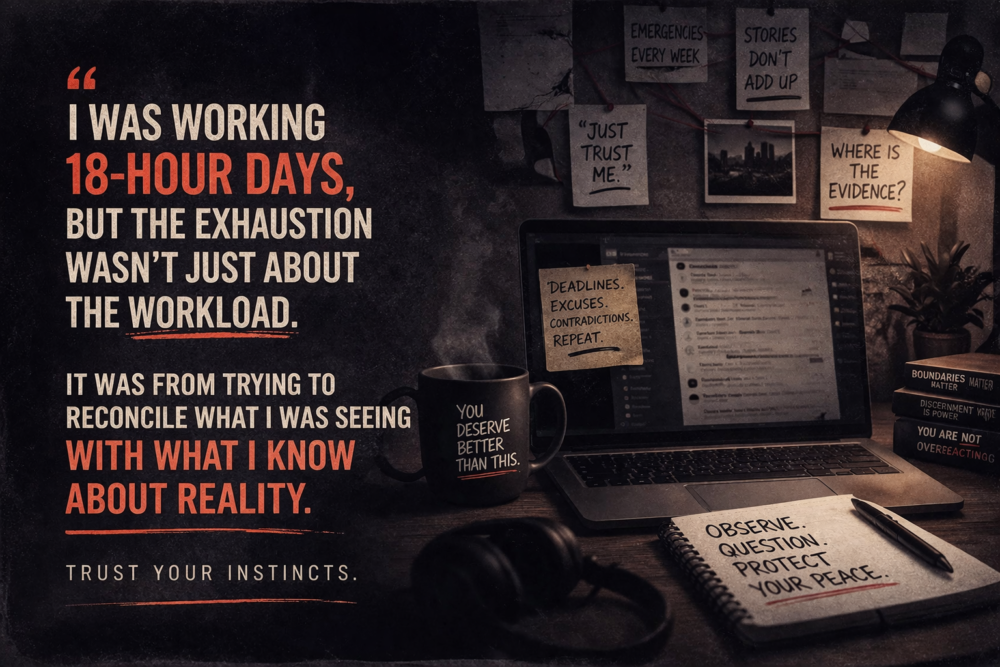
I worked eighteen-plus hour days more times than I can count.
I worked while exhausted, overwhelmed, emotionally wrung out, trying to keep clients from walking while trying to keep the business from collapsing while trying to make sense of the increasingly bizarre behavior of the person at the top.
And because I was remote, and because the pressure never let up, I did what so many remote workers do:
I normalized the abnormal one day at a time.
- A missed deadline becomes understandable because of an emergency.
- A payroll issue becomes understandable because systems are “still being set up.”
- A contradictory story becomes understandable because people under stress say weird things.
- A founder calling you like a friend instead of speaking to you like an employer becomes understandable because startups are “personal.”
- A blurred boundary becomes a culture.
- A crisis becomes a rhythm.
- A lie becomes difficult to isolate because there are now too many of them stacked together.
That is how this happens.
Not all at once.
Piece by piece.
The First Red Flags Aren’t Always the Loudest Ones
If you are picturing this story beginning with some giant obvious scandal, it didn’t. That is not how coercive or deceptive environments usually work.
They begin with friction.
With discomfort you can explain away.
With little moments where your stomach drops but your brain gets there first and says, no, no, there must be a reason.
For me, some of the early warning signs were operational.
- Deadlines were missed constantly.
- Clients became increasingly frustrated.
- Deliverables were delayed, revised, reshuffled, excused, repackaged, and placated into the next week, and the next.
- Expectations being sold did not line up with the reality of what the business could consistently produce.
- There was always a story. Always a reason. Always some extraordinary circumstance that explained why this week had gone off the rails.
And at first, because I am human and not heartless, I believed those reasons.
Who wouldn’t?
- Most of us are trained to give people the benefit of the doubt.
- Most of us do not begin from the assumption that another adult is fabricating major life events in order to manage workflow and loyalty.
- Most of us are not screening employers for elaborate personal fictions.
Because, why on earth would that be part of the job description?
Then there were the payroll issues.
Remote workers, please hear me on this: when someone is vague about payroll, inconsistent about classification, late with money, improvising payment methods, or using personal payment apps to patch over what is supposedly a formal employment relationship, that is not quirky founder energy.
That is a warning siren.
I was told payroll “wasn’t fully set up.” Money was routed in strange ways. Payment did not feel clean, formal, or competently structured. There were conflicting signals around employee status, pay structure, and administrative legitimacy.
Even then, I could feel that something was off. But startups teach workers to expect disorder and call it growth. You start thinking maybe you’re just not “built for startup life” if these things bother you.
Let me correct that framing right now:
Not wanting your wages handled like a roadside shell game does not make you difficult. It makes you awake.
When Crisis Becomes a Management Tool
What turned this from “bad business” into something much darker was the constant deployment of personal catastrophe.
I want to be careful here, because I know how serious these kinds of claims are. I also know what I lived through.
At various points, the company owner used stories involving the death of a child, pregnancy, high-risk multiples, COVID, ICU-level illness, concussions, and premature birth to explain missed deadlines, disappearing acts, operational failures, and escalating demands on the rest of us.
Read that again.
- That is not one stressful year.
- That is not ordinary chaos.
- That is narrative weaponry.
- These stories did not exist in isolation.
They appeared precisely where they were most useful: when pressure was mounting, when deliverables were late, when accountability was near, when sympathy could buy time, when guilt could secure compliance, when shock could shut down questions.
- There was a story about a child dying.
- Later, there were references to living children in ways that directly undermined prior narratives.
- There was a story about being pregnant with triplets.
- Then an ultrasound supposedly showed it was actually quadruplets.
- Then came illness. COVID. ICU. concussions. more delays.
Then came the claim that the babies were born at twenty-one weeks and all survived.
And if that sentence made your brain stop for a second, mine did too.
Because by that point I was no longer simply “concerned.”
I was disoriented.
I was trying to reconcile what I was being told with what I know about reality, medicine, probability, and human truthfulness. I wanted to be wrong for doubting. I wanted there to be an explanation.
I wanted, desperately, for this not to mean what it seemed to mean.
But reality has a way of snapping into focus all at once after you have been straining to see through fog for far too long.
In my case, that moment came through images.
Baby photos had been sent. An ultrasound had been sent. The visuals were meant to solidify the story, to make it undeniable, to transform doubt into guilt. But some images leave such a strong impression that you don’t forget them. One of them caught in my memory like glass.
When I finally searched, what I found was devastating.
The images appeared to come from unrelated public sources on the internet.
- Not family photos.
- Not private evidence.
- Not proof.
Publicly available images.
Stolen, repurposed, and attached to names and stories that were not theirs.
I sat there with that realization and felt a very specific kind of horror.
Not just because it was a lie.
Because it meant that the lie had been engineered.
That this was not improvisational confusion. This was construction.
- The story had props.
- The grief had supporting documents.
- The babies had borrowed faces.
And suddenly the entire last stretch of my employment reassembled itself in a way I could no longer unsee.
“Just Trust Me” Is Not Proof
When I confronted what I found, I did not come in screaming. I did not go scorched earth. I did not accuse wildly. I did what many conscientious workers do even after being lied to: I gave room for an explanation.
- I explained why I had been absent.
- I explained what I had discovered.
- I named the image matches.
- I said I was confused and concerned.
- I said I was left questioning basically everything.
That was the moment where a truthful person could have clarified, corrected, explained, apologized, produced verifiable information, or at the very least engaged with the seriousness of what had been found.
Instead, I got some version of this:
no explanation, everything I told you is true, I need you to trust me, I don’t want to lose you as a friend or an employee.
That response tells you everything.
Because when evidence appears and the answer is not documentation but emotional pressure, that is not truth defending itself. That is manipulation trying to survive exposure.
“Trust me” is not an answer.
It is a demand.
And in abusive or toxic work environments, trust is often treated as something workers owe leadership even when leadership has done nothing to deserve it.
But trust is not a blank check. It is not a bypass around evidence. It is not a tool to silence your own alarm bells.
The moment someone asks you to distrust your own eyes in order to preserve their version of events, you are no longer in a normal professional relationship.
The Cost of Being the Competent One
One of the cruelest things about environments like this is that the most competent person in the room often becomes the containment system.
If you are organized, empathetic, articulate, and willing to work beyond reason, you can keep a dysfunctional operation afloat much longer than it should survive. You become the translator between delusion and consequence. You calm clients. You redo work. You catch errors. You smooth communications. You buy time. You absorb urgency. You become the buffer between a liar and the people they would otherwise lose much faster.
That sounds noble when phrased kindly.
In reality, it is ruinous.
- I lost sleep.
- I lost peace.
- I lost huge amounts of time.
I lost faith in my own instincts for a while because living inside contradiction day after day will do that to you.
It makes you second-guess what should be obvious. It makes you more tired than the workload alone can explain. It makes you emotionally overextended because you are not just working—you are also constantly calibrating around instability.
And the whole time, because this is remote work, your suffering is largely invisible.
- Nobody sees your face after the eleventh hour of the day.
- Nobody sees you trying to answer angry clients with professionalism while privately realizing you may have been helping hold up a business that should not have been operating the way it was.
- Nobody sees the moment your stomach drops reading a message about payroll, or a medical emergency, or a client crisis, and realizing you already know which part of yourself is going to get sacrificed to deal with it.
Remote work can be beautiful.
It can also be the perfect environment for exploitation when there is no structure, no transparency, no accountability, and no witness.
There Were Business Lies Too
The personal lies were shocking, but the business lies matter just as much, if not more, because they are often the part people are most tempted to dismiss as “messy startup stuff.”
Do not do that.
- There were problems involving compensation and payment structure.
- There were inconsistencies involving employment status and documentation.
- There were representations about the business that did not line up cleanly with what was actually happening.
- There were client-management practices that relied heavily on delay, placation, and explanation rather than consistent delivery.
And there were work-product concerns serious enough that I was, at one point, looking at a message referencing dozens of fraudulent references in academic material.
Pause there.
Fraudulent references.
Not weak sources. Not formatting mistakes. Not something mildly embarrassing that needed editing polish. Fraudulent references.
If you work in or around academic support, tutoring, dissertation services, coaching, consulting, or anything that trades on expertise and trust, this should alarm you deeply. Because once you are asking staff to calmly manage a client while acknowledging internally that the work contains fabricated or fraudulent support, you are no longer dealing with sloppy operations.
You are dealing with ethical rot.
And if you are the worker being asked to smooth that over, you are being placed in moral and reputational danger whether you consent to that clearly or not.
That is another thing toxic founders do well:
they make you responsible for cleaning up risks you never knowingly agreed to take.
Why People Stay
This is the part I need other workers to understand most, because from the outside these situations always look simpler than they feel from within.
People ask: why didn’t you leave sooner?
- Because remote exploitation rarely looks like exploitation on day one.
- Because lies built around tragedy are difficult to challenge without feeling monstrous.
- Because manipulative people do not just ask for your labor; they cultivate your sympathy.
- Because when your boss frames you as special, trusted, essential, and close, it becomes emotionally expensive to admit that the relationship itself may be part of the trap.
- Because by the time the pattern is obvious, you are already exhausted.
- Because you keep thinking the next explanation will finally make it all make sense.
- Because you are trying to be fair.
- Because you have bills.
- Because in a remote environment, there are often fewer reality checks.
- Because there is no break room where coworkers exchange The Look.
- Because there is no office energy shift to validate that what is happening is off.
- Because your laptop becomes both your job site and your gaslighting chamber.
- Because competent people are often conditioned to solve problems instead of naming them.
- Because decent people do not want to believe they are being played by someone who can cry on cue, collapse on cue, bond on cue, and manufacture catastrophe whenever needed.
That is why people stay.
Not because they are naive.
Because they are human.
Red Flags I Will Never Ignore Again
I want this section to live in writing because I hope someone else finds it before they get as deep in as I did.
If you are considering a remote role, especially with a startup or solopreneur-led company, pay attention to these things early:
- If payroll is inconsistent, improvised, or personal, stop romanticizing it.
- If your role is unclear but your responsibilities are massive, pay attention.
- If the founder leans on personal intimacy and blurred boundaries early, pay attention.
- If every missed deadline comes with an extraordinary personal tragedy, pay attention.
- If you are constantly asked to soothe clients while leadership stays inaccessible, pay attention.
- If hard questions are met with emotion instead of documentation, pay attention.
- If you find yourself working absurd hours to compensate for someone else’s instability, pay attention.
- If you keep thinking, “this is weird, but maybe…” pay attention to the first half of that sentence.
We are taught to override our instincts in professional settings because “being a team player” is often coded as accepting far too much. But discernment is not disloyalty. Verification is not cruelty. Boundaries are not a character flaw.
And if an employer’s entire world collapses when asked for evidence, that tells you the evidence matters.
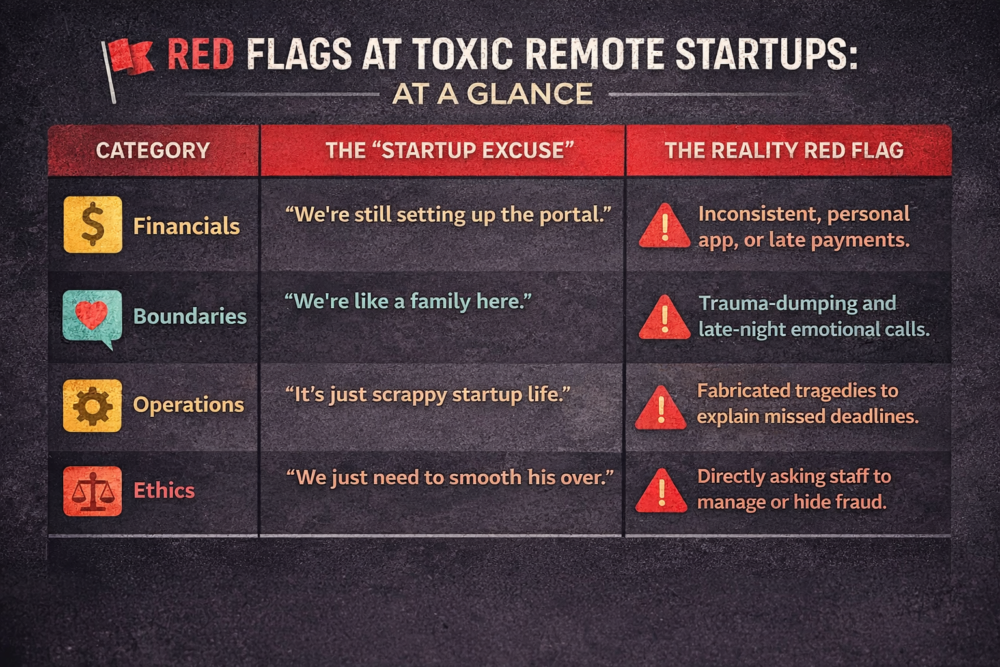
I’m Writing This Because Silence Protects Predators
I stayed quiet for a long time.
Partly because I was trying to process what had happened.
Partly because once you realize you have been manipulated, there is a secondary humiliation that arrives with that understanding. You replay everything. You revisit your own responses. You wonder what you missed. You feel angry, embarrassed, sad, and strangely grief-stricken all at once—not just for the time lost, but for the reality you thought you were participating in.
There is a real kind of grief in discovering that what you believed was meaningful was, in many ways, manufactured.
But silence is one of the things people like this depend on.
- They depend on confusion staying isolated.
- They depend on workers doubting themselves.
- They depend on clients only seeing their own slice of the problem.
- They depend on everyone being too overwhelmed, too compassionate, too ashamed, or too busy cleaning up the wreckage to step back and name the pattern.
So I am naming it.
I worked for a remote business owner who appeared to use fabricated crises, false representations, emotional entanglement, and chronic operational instability to keep a business functioning far longer than it should have.
I was overworked, emotionally manipulated, and placed in ethically compromising situations.
I witnessed enough contradiction, enough deception, and enough dysfunction to know this was not bad luck. It was a pattern.
And I am writing this because I do not want another worker, contractor, assistant, writer, editor, or client to walk into something like this thinking they just need to be more patient, more loyal, more flexible, more understanding.
Sometimes the problem is not that you have failed to adapt.
Sometimes the problem is that you are standing inside someone else’s lie.
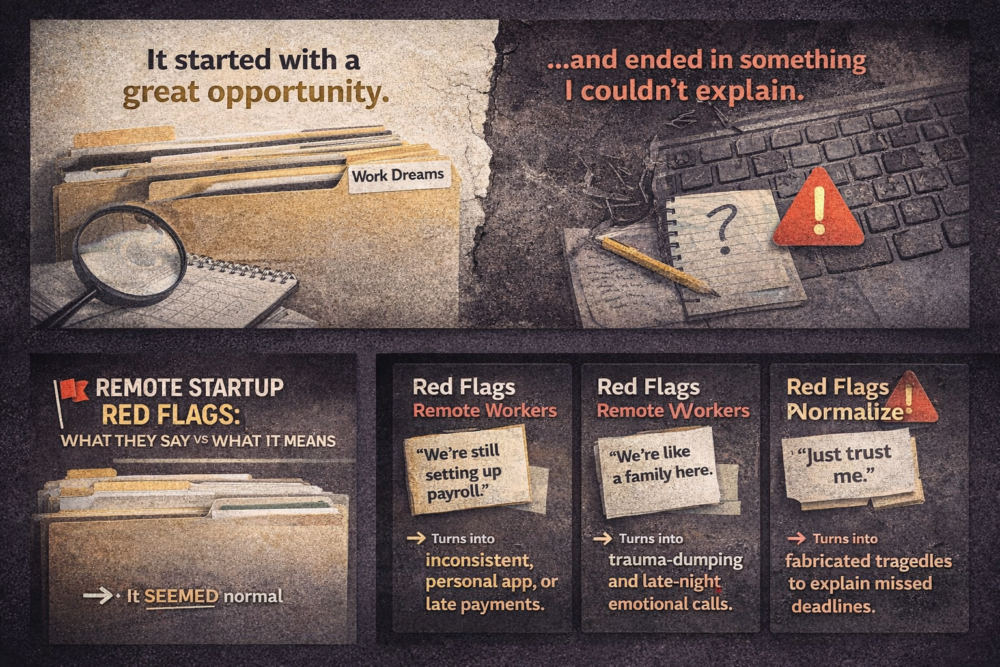
What I Know Now
- I know now that remote work requires due diligence that goes beyond the job description.
- I know now that founders can weaponize vulnerability.
- I know now that chaos is profitable when someone else is doing the cleanup for free, emotionally or otherwise.
- I know now that “we’re like family” can be a threat disguised as warmth.
- I know now that a startup without systems is not automatically innovative—it may simply be unsafe.
- I know now that a person asking you to trust them over evidence is asking for power, not understanding.
- I know now that my instincts were not weak. They were delayed by overload, empathy, and proximity.
And I know now that telling the truth about what happened is not pettiness.
It is a form of protection.
For me.
For the version of me who kept trying to make it make sense.
And for anyone else who may be standing in a remote role right now, staring at their screen, feeling that quiet dread in their stomach, wondering if they are overreacting.
You might not be.
You might be seeing the edge of something much bigger than you have words for yet.
Listen to yourself sooner than I did.
I am intentionally withholding names in this piece. My goal is not spectacle. My goal is to document patterns of deception and exploitation in remote work so others can better recognize them. If you have experienced something similar, trust your instincts, document everything, and seek appropriate legal or professional guidance where needed.
If you feel like you’re constantly trying to make something make sense that refuses to …
That may not be confusion.
That may be your clarity trying to break through.