
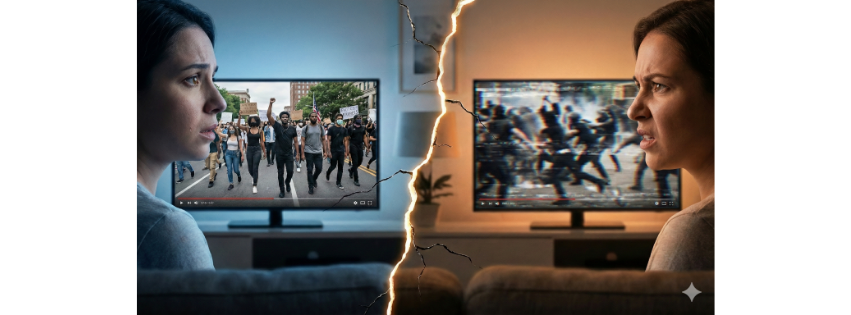
I know what I am seeing.
I stare at the screen, watching the same video that millions of other Americans are watching. But what unsettles me most isn’t just the event itself—it is the realization that we can all hear the same words, witness the same violence, and somehow walk away with entirely different understandings of what just occurred.
Not different opinions. Not different interpretations. Different realities.
This is not normal. It is not healthy. And, as history warns us, it is not sustainable. Societies don’t fracture solely through open violence; they fracture when people can no longer agree on what is real, what is dangerous, or what is unacceptable. When shared reality collapses, trust collapses with it.
We are currently living in the dust of that collapse.
From Meaning to Reality
There was a time when Americans argued fiercely about what events meant. We disagreed about motives, policy, and consequences. But we generally agreed on the baseline of what happened.
That line has been erased.
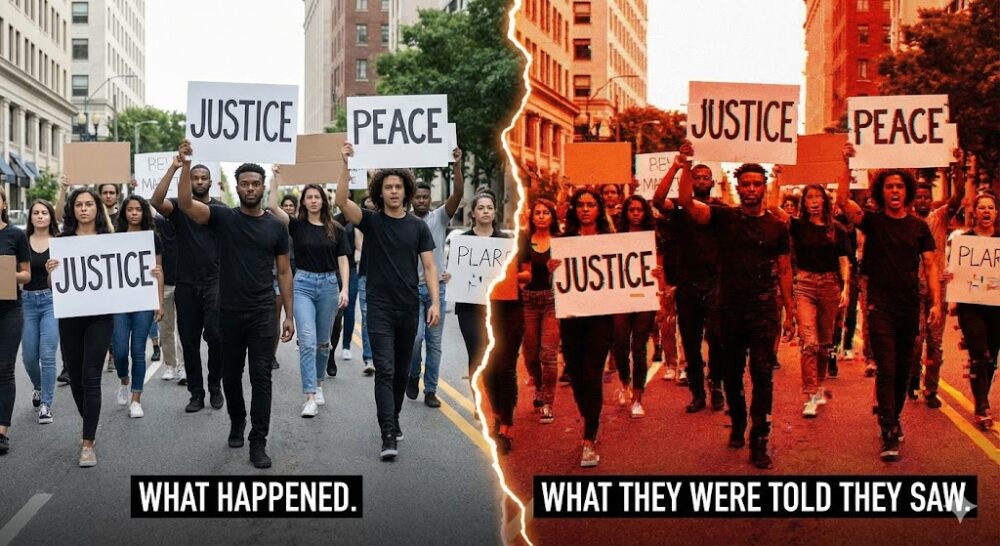
Today, video evidence circulates widely—from protests to law enforcement encounters—yet we are frequently told not to believe our own eyes. Official statements flatly contradict raw footage. Victims are posthumously recast as threats. Clear sequences of events are reframed until they are unrecognizable.
And when you point to the video and say, “But that’s not what happened,” you are accused of being naïve, manipulated, or dangerous. This isn’t healthy skepticism. It is social gaslighting.
The Scale of the Lie
Gaslighting is usually discussed as a personal abuse tactic—convincing a partner to doubt their perception, memory, or sanity. Social gaslighting is what happens when that dynamic scales to the level of a population.
It happens when political loyalty and media ecosystems train us to distrust our eyes unless our “side” approves of what we’re seeing.
- If your side says it didn’t happen, you’re expected to believe it didn’t.
- If your side says the victim was the real threat, you’re expected to accept that framing—even when the video suggests otherwise.
Over time, we stop trusting ourselves. We outsource our perception. Reality becomes a team sport. This is perhaps the most destabilizing force in a democracy because when we cannot agree on basic facts, accountability disappears. And when accountability disappears, power fills the vacuum.
Manufacturing Confusion
Civil unrest does not usually begin with chaos. It begins with confusion. It begins when reality becomes partisan, questioning becomes disloyalty, and empathy becomes weakness.
Most Americans are not looking for conflict. They are simply trying to make sense of a relentless, emotionally charged news cycle where events move faster than the human brain can process. That vulnerability is being exploited—not just by fringe actors or online trolls, but by people in power who understand that confusion and fear are useful tools.
We are witnessing a dangerous erosion of democratic norms in real-time: the open rewriting of recent history, attacks on independent institutions, and the normalization of aggressive state power without transparency.
Much of this has occurred under the current political leadership, and that deserves scrutiny. But we must also acknowledge the psychological toll: If every moment is framed as apocalyptic, people shut down. If fear becomes the organizing principle, violence becomes imaginable.
The “Sky Is Blue” Test
Recent incidents involving federal immigration enforcement have made this dynamic painfully clear. We have watched videos of lethal encounters involving ICE agents, only to watch official narratives attempt to invert what appears on the screen.
Whether one ultimately agrees with the official explanation is secondary. The core issue is that we are being told, repeatedly, not to trust our senses.
That breaks something fundamental. When video evidence, autopsy findings, and eyewitness accounts are dismissed based on who presents them, we are no longer debating policy. We are disputing reality.
Here is the simplest test, one we cannot afford to fail:
If the sky is blue, it should not become green because politics demands it. If something happened, it should not become “fake” because it is inconvenient. If harm occurred, it should not be erased because it complicates a narrative.
We Do Not Have to Choose
We are often told we must choose between naming harm and preserving unity, or between truth and peace.
That is a false choice. There is no peace without truth. There is no stability without trust.
Most people—left, right, and center—want the same basic things: safety, dignity, fairness, and a future that doesn’t involve tearing one another apart. But to stop the slow march toward civil unrest, we have to resist the pressure to abandon our own eyes.
Most Americans are not trying to destroy the country; they are trying to protect what they believe it is. They are operating inside information ecosystems that reward outrage and punish nuance. That doesn’t excuse harm, but it explains how harm spreads.
Reality cannot belong to a political party. Because once it does, truth becomes optional—and power becomes everything. We know how that story ends. Let’s write a different one.
I’m trying to make sense of this shift in our culture. If this resonated with you, please share it with one person who you think needs to hear it, or leave a comment below: When was the last time you felt like you were seeing a different reality than the news reported?
Author’s Note: I wrote this not to inflame, but to steady. We are living in a moment where reality itself is being fractured along political lines. This is my attempt to name that and to call us back to something we can still share.