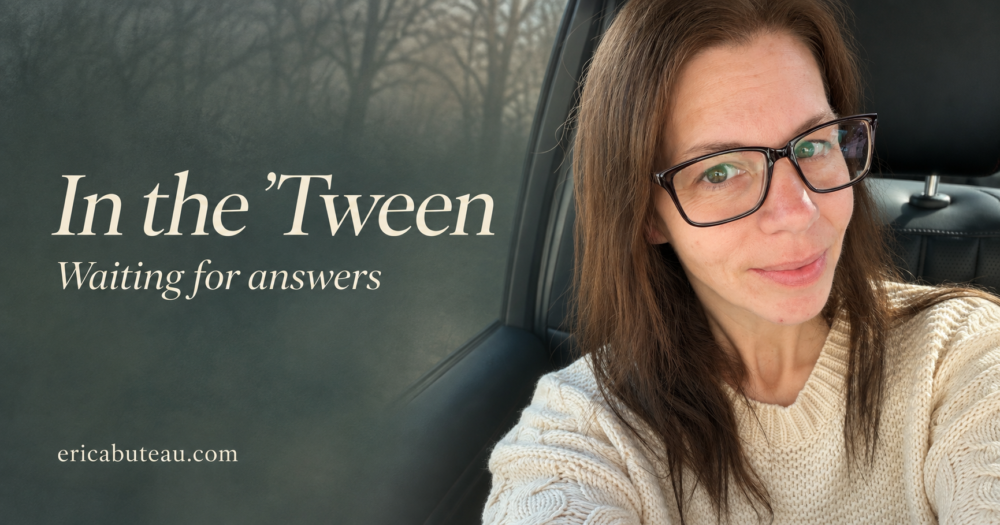
There’s a space between finding out something might be wrong and finding out just how wrong it is.
I’ve been thinking of it as the ’tween.
The “well, that’s bad … but how bad is it?” space. When you have enough information to be scared, but nowhere near enough to know what you’re supposed to do with that fear.
You’re waiting for another test, another call, someone to look a little closer. Meanwhile, the laundry still needs switching. Someone asks what’s for dinner. You answer a perfectly ordinary question while a completely different conversation is happening inside your head.
What if?
How long?
What happens next?
You try to be reasonable. You remind yourself that there are other explanations. You hear yourself telling someone, “It’s probably fine,” and realize how badly you need them to agree.
Then the pleading starts.
Please let this be something simple. Something fixable. Please let me come back to this exact ordinary day and complain about something ridiculous.
You start making promises you haven’t been asked to make. You’ll take better care of yourself. You’ll stop putting off the trip, the conversation, the thing you keep saying you’ll get around to.
And sometimes you catch yourself doing it and feel a little foolish. You don’t even know anything yet.
But that’s the trouble. You don’t know.
You start thinking about who you would tell, and how. You wonder whether saying it out loud will help or make it more real. You want someone to understand why you’re distracted without having to watch their face change when you explain.
All of this can happen while everything around you is still quiet.
There’s no emergency anyone can see. Nothing to cancel yet. Maybe you’re still showing up, making plans, answering messages. Or maybe the emotional weight is so heavy that even something as simple as putting one foot in front of the other feels like too much to bear.
Either way, you just keep checking your phone.
Sometimes the news comes, and you have to learn how to live with it.
Sometimes you get to exhale. You make the relieved calls. You tell people it looks okay, and you hear yourself laughing for the first time in days without having to work at it.
And sometimes the relief comes with more questions.
I don’t have the mountain I was most afraid of—the one that starts with a C. And I am deeply grateful for that. But I do have a little more than a molehill to climb.
Trouble is, I seem to have the musculoskeletal system of something you’d find in a Spirit Halloween store. Decorative use only. Questionable structural integrity. Definitely not rated for this climb.
I can be grateful for the reassuring news and still need a minute to figure out how the hell I’m going to get up this hill.
There are words like “severe.” There are findings that might help explain the pain you’ve been living with. There are questions about what treatment will involve, what you’ll be able to do, and how much of your everyday life might have to change.
You can feel the relief and still have your stomach drop.
I found myself asking whether the average person would feel concerned, stressed, or upset about results like these. As though I needed to check whether my reaction was reasonable before allowing myself to have it.
Was I making too much of it? Should I just be grateful the scariest possibility looked less likely? Was I allowed to be shaken by everything that remained?
That’s another part of the ’tween I hadn’t quite found words for: how quickly you can start judging your own fear.
You remind yourself that other people have it worse. You worry that talking about what’s still wrong will sound ungrateful for what went right. So you try to make the update easier to hear. You lead with the good news, keep the rest brief, and find yourself alone with the questions again.
How much will this affect my life?
Will it get worse?
What happens now?
I’m trying to give myself room to feel all of it.
To be relieved about one finding and upset about another. To appreciate an answer and still be frightened by what I don’t understand. To admit that wondering about my ability to work, walk, care for the people and animals who depend on me, and keep doing the things I love carries weight.
A reassuring result can ease one fear while leaving others unresolved. And after days of bracing yourself, you may need a little time to believe that you can loosen your grip.
Sometimes the ’tween lasts beyond the first answer. You’re waiting for the appointment, the explanation, the plan. You know more than you did yesterday, and you’re still trying to understand what it means for tomorrow.
I think that waiting deserves a little tenderness, too.
We’re allowed to admit how frightened we were, even when we’re grateful for how things turned out. We’re allowed to be concerned about what comes next. We don’t have to wait for the worst possible news before we let someone know we’re having a hard time.
Even if the storm misses you, you still spent those days watching the sky.